

How Sealy’s R&D delivers measurable performance.
Last month featured an in-depth look at the unique and proprietary technology that makes Sealy Posturepedic Spring Systems what they are today. Designed and developed by Sealy’s very own team of engineers, a huge amount of focus and resource is invested into the design & development process. It’s the backbone of the business’ product offering and forms the core of its Sealy Posturepedic Technology.
In a market where many brands claim to be “different” or “better,” Sealy continues to anchor its competitive position in something far more substantial: Research and Development. For the business, R&D is not a marketing narrative it is the technical and scientific foundation that underpins every product it brings to market. Every product launched is the direct result of this process, led by a world-class research and development centre in Australia.
Sealy clearly differentiates between Research and Development, two complementary disciplines working in tandem. It is about setting higher benchmarks through advancements in science and engineering, inventing new solutions, refining existing technologies and ensuring innovation is built on a robust technical foundation.

Development then translates that research into commercially viable products. This includes everything from spring geometry and comfort layer configuration to prototyping and performance validation. This long-term investment has evolved over the last decade, with the company building a global team spanning multiple nationalities, disciplines and technical specialisms.
Central to Sealy’s R&D philosophy are the Posturepedic principles of Support, Comfort and Durability. These three pillars define what the company believes makes the best mattress and, critically, they are measurable.
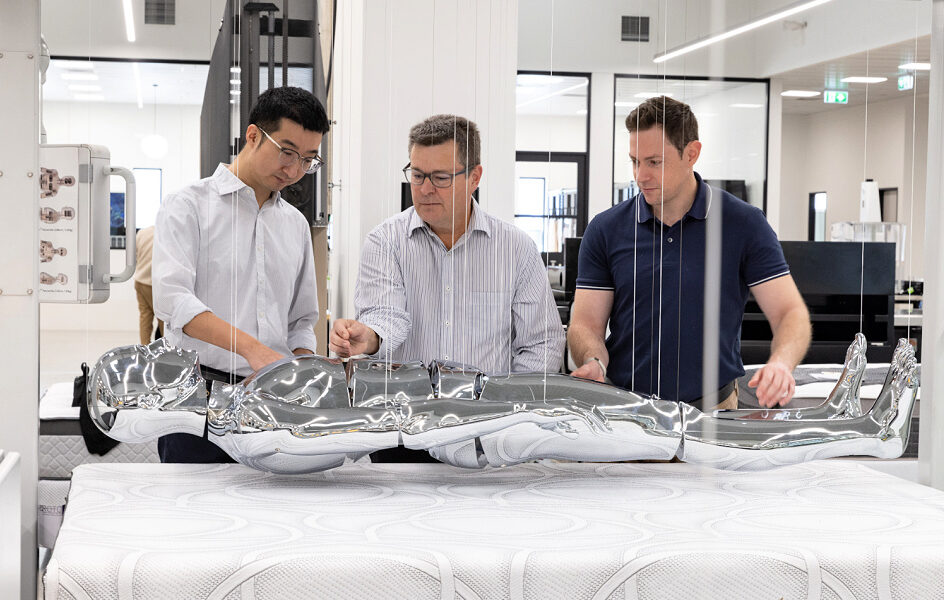
Support is engineered to help maintain correct body alignmen. Through specialised testing that simulates real-world sleeping conditions, angles and body positioning are assessed against orthopaedic benchmarks. Performance is not subjective; it is quantified.
Comfort focuses on pressure relief, temperature regulation and minimising partner disturbance all factors that influence sleep quality. These variables are measured using precise metrics, from pressure mapping to temperature and motion analysis. The aim is to create a mattress that not only feels comfortable initially but performs consistently throughout the night.
Durability ensures that both support and comfort are maintained over time. Through demanding fatigue and stress testing, Sealy simulates years of use, measuring wear, height retention and material resilience. Individual components are also pushed to their limits to validate long-term integrity.

While many manufacturers may optimise for one of these areas, Sealy’s engineering challenge and point of differentiation lies in delivering all three simultaneously. Adjusting springs, foams, quilting or edge support can positively impact one principle while compromising another. Achieving balance requires sophisticated modelling, testing and refinement.
Beyond technical performance, Sealy’s R&D programme is also guided by manufacturing excellence and consumer appeal. Products must meet the highest construction standards while remaining visually compelling in-store and online.
As technology evolves, so too does the product. Continuous improvement is embedded in the process, with coil design and performance regularly refined in line with new research findings and scientific advancements.
For retailers, this structured approach translates into a clear commercial advantage. Rather than relying on subjective claims, Sealy’s products are supported by measurable data. In an increasingly competitive marketplace, that level of technical rigour provides something more powerful than marketing language: demonstrable proof.


