
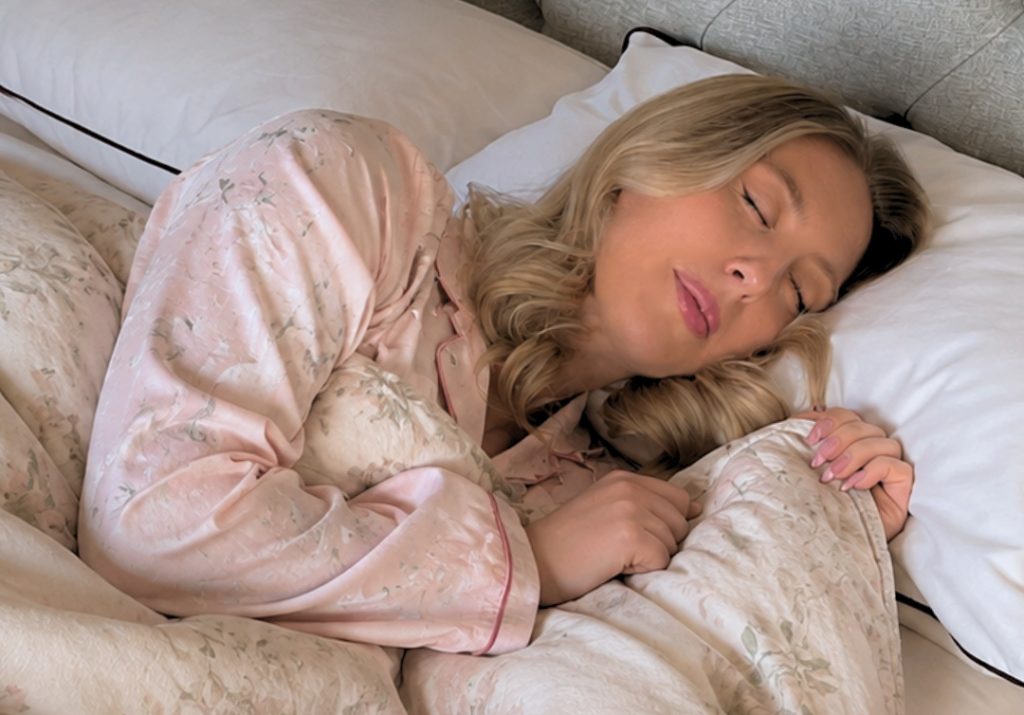
With 49% of Britons reporting they do not get enough sleep, and a further estimated 14 million people living with undiagnosed sleep disorders, millions of tired adults are turning to social media for answers.
As a result, the hashtag #Sleep has surpassed 5.3 million posts on TikTok, driving viral interest in everything from “sleepy girl mocktails” to brown noise and biometric tracking.
However, medical experts warn that the internet’s latest obsession, ‘sleepmaxxing’, may actually be causing the very insomnia it promises to cure.
According to Dr Katrina O’Donnell, a GP with over 30 years of clinical experience and Sleep Health Advisor at Land of Beds, obsessing over sleep scores and chasing online trends is creating a surge in orthosomnia. This is a recognised condition where perfectionism around sleep data triggers nighttime anxiety:


Dr. O’Donnell says: “Sleepmaxxing mixes genuinely solid advice with one of the internet’s worst habits: obsessing over perfection. If you’re lying awake at night worrying about whether your deep sleep percentage was high enough, you’ve already missed the point. Sleep isn’t something you can force or game like a scoreboard, it’s something you allow.”
Evaluating SleepTok’s biggest viral trends to separate biological fact from internet friction, Dr O’Donnell warns that many popular hacks are vastly overhyped.
“As social media sleep trends go, the ‘sleepy girl’ mocktail is more grounded than most,” explains Dr O’Donnell. While combining tart cherry juice and magnesium powder is biologically plausible, because cherry juice contains natural melatonin and tryptophan, she cautions that the wider proof is thin: “The evidence for magnesium remains mixed, and the sparkling water doesn’t add anything biologically useful. That’s just how it’s served. The wind-down routine around the drink is likely doing more than the drink itself.”
Similarly, while coloured noise trends flood social media, Dr O’Donnell notes that white, pink, and brown noise simply rely on ‘auditory masking’ to cover up sudden ambient sounds that cause micro-awakenings.
Furthermore, Dr O’Donnell reassures that waking up at 3 AM is a biological event, not a personal failure. “There’s a real biological reason for it,” she says. Early deep sleep naturally gives way to lighter REM sleep, coinciding with early-morning cortisol rises that can be further heightened by shifting oestrogen levels in perimenopause.
Interestingly, research shows that 71% of Britons already maintain a consistent bedtime, yet experts stress that people are anchored at the wrong end of the day.
“The single most powerful thing you can do is anchor your wake time,” says Dr O’Donnell. “Pick a time and get up at that same time every day – regardless of how you slept. You should also get outside into daylight within the first hour of waking. That light signal resets your master clock, and everything else, like your sleep pressure and melatonin timing, adjusts around that anchor.”
Instead of spending money on trending supplements, tracking devices, or elaborate rituals, returning to core sleep hygiene offers far superior results.
Keeping the bedroom between 16 and 18°C, following the 20-minute rule to leave the bed if sleep does not come, and replacing mattresses older than seven to ten years will eliminate the subtle discomfort that causes hidden awakenings throughout the night.
Dr O’Donnell also offers one surprisingly simple, evidence-backed tip: wearing socks to bed. “Cold feet delay sleep onset because the blood vessels in the extremities play a major role in how your body redistributes heat. Wearing socks to bed helps you fall asleep faster, I’ve recommended it to more patients than I can count.”
Ultimately, every viral hack has its limit, and Dr O’Donnell advises skipping social media entirely if sleep disruption persists for more than three to four weeks and impacts daytime performance or mood. “Use those platforms as a starting point, not an endpoint,” advises Dr O’Donnell.
Anyone suffering from chronic sleep issues should speak to a GP and ask specifically for Cognitive Behavioural Therapy for Insomnia (CBT-I). This remains the official NICE-recommended first-line clinical treatment for insomnia and continues to prove vastly more effective than social media trends or medication.